The 3D Effect in Print: Doming vs. UV Printing. Which Sticker Marking Technique Should You Choose?
Choosing the right marking technique often determines how customers perceive a product. When you hold a promotional item with a domed logo in your hand, you immediately sense you’re dealing with higher quality. Two solutions currently dominate the market when it comes to achieving this effect: traditional 3D doming and the modern technology of UV digital printing. While both approaches set out to give a logo’s artwork depth, they go about it in completely different ways.
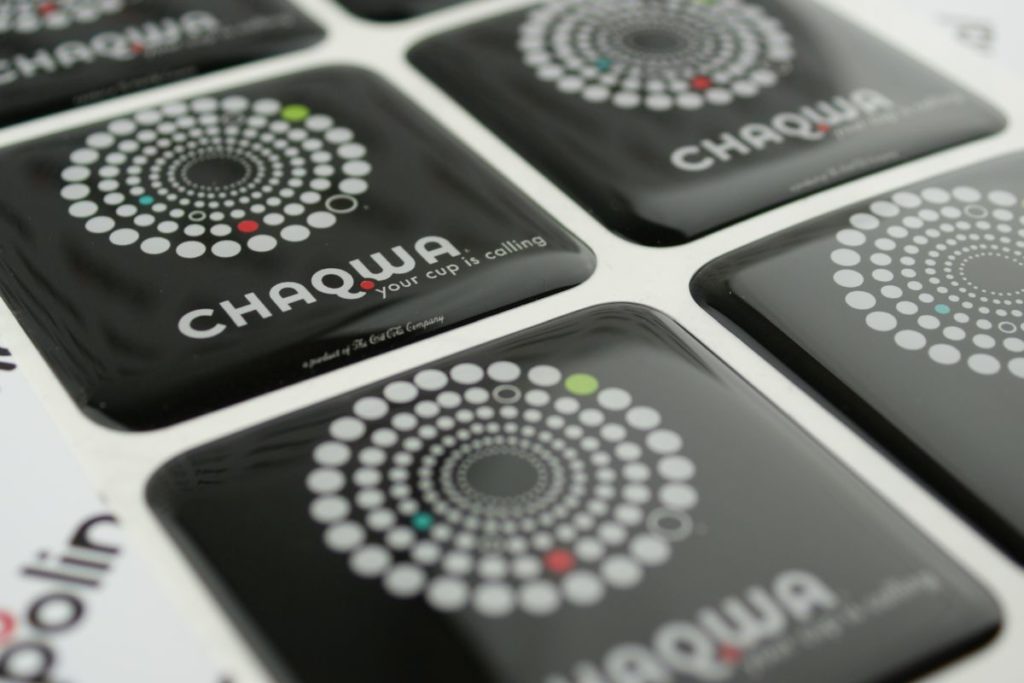
Introduction: domed aesthetics versus digital print
You’re probably wondering what really sets these two methods apart. Producing doming stickers is a process in which a layer of clear polyurethane resin is applied to a previously printed sticker.
So what does UV printing involve? UV digital printing is a non-contact marking method — a technology that cures the ink directly on the surface of the material using UV light. In the case of the structural version, the UV printer lays down multiple layers of ink, one on top of the other, in this way building up a texture that can be felt under the finger. The additional option of selective UV varnishing is used for highlighting details in a design.
Why does this matter? Because each of these techniques shapes a different brand image. One puts its money on a luxurious, soft sheen, the other on raw precision and contemporary detail. The choice between them will affect not only the appearance, but also how long the print stays unscathed.
Domed stickers – increase brand visibility!
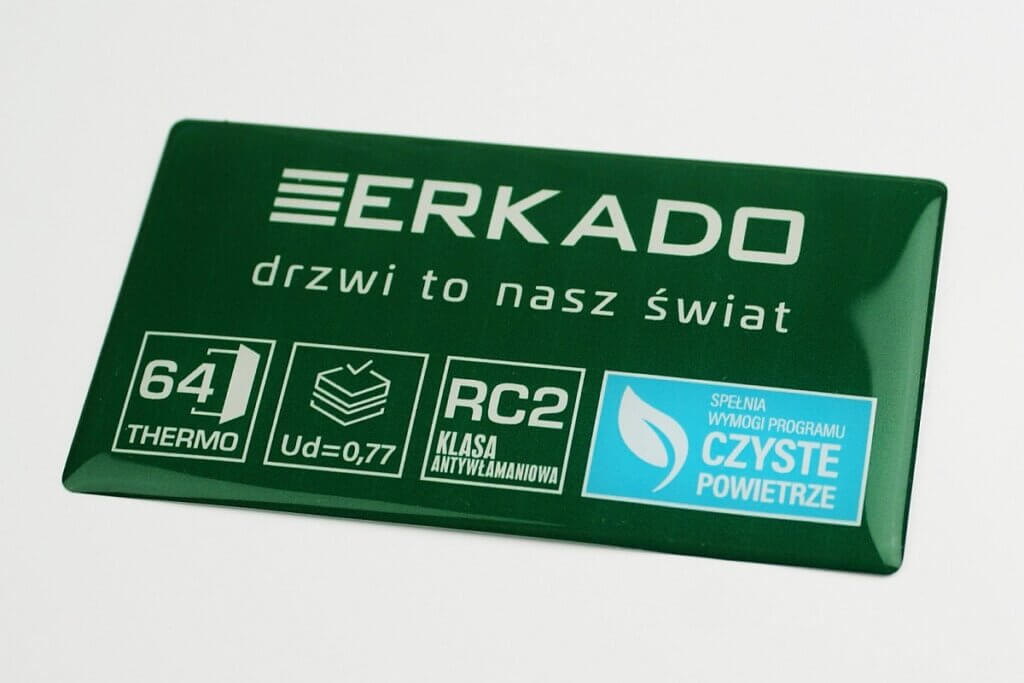
3D doming: a deep lens and the gleam of promotional stickers
If you’re after something that’ll catch the eye from a distance, the dome of polyurethane is second to none. Thanks to the use of polyurethane resin, that distinctive lens effect is formed. This layer not only protects the artwork — it visually magnifies the details and makes the colours richer and more vivid.
The physical dome in this technique is very pronounced. The sticker takes on gently curved edges and a consistent thickness of about 2 mm. This makes the logo look as if it’s been set into crystal-clear glass. The tactile experience matters, too. The resin is flexible. Interestingly, it has a self-healing ability — press it with your fingernail and it’ll bounce back to its original shape a moment later. It’s the ideal solution when a premium feel is what you’re after.
UV printing: detail and the texture of the print
Modern UV printing technology offers an entirely different take on the third dimension. Here, the 3D effect is “layered”. A UV printer can apply selective varnish or ink repeatedly in the same spots, building up precise structures. It isn’t one thick drop — it’s an intricately built texture.
The main advantage is remarkable precision. UV printing allows for micro-details that couldn’t be achieved by coating with resin without the risk of it running. You can create a leather effect, fine raised dots or Braille lettering. On top of that, the UV technique offers a range of finishes. On a single surface, you can pair a matt print with glossy elements, which gives a very smart, contemporary contrast. UV lamps also mean that the print is ready as soon as the production sheet comes off the machine and doesn’t need any further drying time.
Innovative UV digital printing also stands out for its colour-laying qualities — much like screen printing, and in contrast to solvent printing, it creates a layer of ink that doesn’t let light through so easily. This property comes into its own particularly with prints on transparent films.
A direct comparison of the visual parameters
Let’s take a look at the specifics that will help you decide:
| Feature | 3D Doming | UV Printing (structural) |
| Profile height | Consistent, tall (approx. 2 mm) | Low, built up in layers |
| Edges | Rounded, gentle | Sharp, precise |
| Gloss | Very high (glass-like effect) | From matt to high gloss |
| Transparency | Full transparency of the base | Option of opaque or semi-transparent printing |
Print technique resistance and durability in practice
In the advertising industry, durability matters just as much as aesthetics. How do these technologies fare with the passage of time? Doming has a wide range of uses because it’s exceptionally resistant to external factors. High-quality polyurethane resin doesn’t yellow under UV radiation and copes admirably with tough weather conditions. Thanks to its flexibility, it’s also all but indestructible mechanically — it’s hard to scratch or chip.
UV prints, for their part, are characterised by high hardness. UV inks are resistant to abrasion and to most chemicals, which is crucial on control panels or rating plates. However, under very strong mechanical impacts, a rigid UV print may be more prone to chipping than flexible resin. When it comes to cleaning, both surfaces respond well to standard detergents, although polyurethane domed stickers are easier to keep clean thanks to their smooth, streamlined structure. Some UV inks retain greater flexibility, allowing for printing on films and creating more flexible premium labels.
The use of UV printing — when and on what materials should you choose which technology?
The choice comes down to what you’re actually marking. Doming is the king of the automotive and white goods sectors. A logo on a boot lid or a smart emblem on a fridge is almost always a 3D sticker. It also shines on exclusive promotional gifts such as keyrings, where a luxurious character that’s pleasing to the touch matters.
UV printing is an innovative technique that comes into its own where information and precision are key. It’s the ideal solution for rating plates, industrial panels or bespoke packaging. Because UV printing on glass, wood, metal or PVC is possible, this technology makes it possible to mark objects directly, without the need to use film. UV printers handle items such as power banks, lighters and pens with ease — products where durable direct printing is a must.
The ability to print UV on metal or wood makes this a marking technology that delivers effects and markings unavailable through other printing techniques. Thanks to UV printing, manufacturers are broadening both the scope and the range of their promotional products and markings.
Summary: UV printing or doming? What wins out in your project?
There’s no single, universal answer as to which method is better. It all comes down to your needs and your budget. For small print runs and when you need to quickly personalise a lot of different items, UV printing often turns out to be the more economical option. However, if you’re creating a series of premium products and you want your logo to be the centrepiece — a jewel-like focal point — polyurethane coating will be the better choice.
Remember the shape of the substrate, too. Doming technology requires a flat surface on which the resin can set freely, without running off the sides. UV printing is a technology that’s a touch more flexible in this respect, though it too is at its happiest on flat or gently curved surfaces.