Eco-Friendly Doming: Can 3D Domed Stickers Really Be Green?
The environmental challenge in the world of 3D marking
Have you ever wondered what makes that distinctive, domed layer on your favourite keyring or laptop logo so durable? It’s down to doming technology, which has dominated product marking for years. Traditionally, this process relies on polyurethane and epoxy resins. While they deliver an astonishing depth of image, their production raises plenty of questions when it comes to the environment. The advertising industry is today faced with a tough question: can we hold on to that three-dimensional sheen without harming the planet in the process?
The pressure for change hasn’t come out of nowhere. Growing consumer awareness, along with stringent EU regulations — such as those covering restrictions on diisocyanates — is forcing manufacturers to look for new avenues. In my view, eco doming has ceased to be merely a marketing ploy. It’s a genuine technological shift, one that’s unfolding before our very eyes.
A revolution in the raw materials for doming stickers: bio resins and recycling
The foundation of every 3D domed sticker is resin. In the eco version, traditional petroleum-based derivatives are being replaced by renewable raw materials. The biggest technological shift came a few years ago, when the industry did away with material that contained mercury. Mercury-free resins are products that are friendlier to those who use them. Resins of plant origin — so-called bio-based ones — make use of natural oils, which substantially lowers the carbon footprint. When you touch a sticker like this, you can’t tell the difference, but the environment feels it very distinctly. For now, owing to the production costs of such materials, they aren’t yet the industry’s leading solution.
The next step is the reduction of VOCs, or volatile organic compounds. Eliminating them is not just a nod to the atmosphere — it’s also a genuine improvement in safety for the workers who operate doming machines day in, day out. But being green isn’t only about what’s on the outside. What’s underneath matters just as much. Instead of standard self-adhesive film, recycled substrates — such as rPET film, or FSC-certified film — are increasingly being used. As a result, the entire sticker — from the adhesive right through to the tip of the clear lens — becomes more sustainable.
A sustainable artwork printing and production process in the marking industry
Simply using green raw materials is only half the battle. The real progress becomes clear in how the stickers are made. Modern doming technology is putting its money on energy efficiency. Traditional curing ovens (where the coated sheets end up) were capable of gobbling up huge amounts of electricity — these are being replaced by LED UV systems. A solution like this uses a fraction of the energy and drastically speeds up sticker production.
Another aspect is the zero-waste philosophy when it comes to dispensing. Precision machine-based systems mean the resin layer lands exactly where it should, without any excess ending up in the bin. It’s pure mathematics and pure material savings. The whole thing is tied together by material certifications such as REACH and RoHS, which offer the assurance that there is no toxic chemistry in the composition.
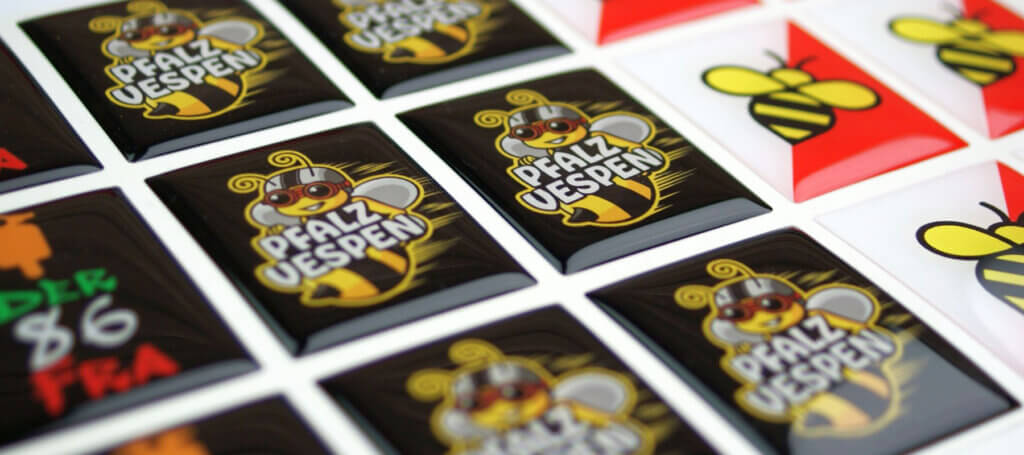
3D doming markings are created by coating the sticker’s surface with a transparent layer of two-component polyurethane. The layer of clear polyurethane resin creates a flexible lens on top of the printed artwork, protecting the colour and delivering resistance to damage.
The durability of a gel domed sticker as an environmental benefit
It may sound like a paradox, but the exceptional durability that doming technology offers is in itself eco-friendly. Why? The answer is straightforward: a longer product life cycle means less frequent replacement. Where an ordinary printed image fades or wears away after a few months, doming stickers — with their printed artwork safely shielded — remain unscathed for years.
Domed polyurethane does a superb job of protecting the print from mechanical damage and UV radiation. When we compare doming with ordinary paper stickers, it quickly becomes apparent that investing in “durable” eco-friendliness makes good sense. Rather than producing ten cheap film stickers that will soon end up in the bin, it’s better to create one that will stand the test of time and lift the look of a product for the long haul.
Barriers and the future of doming technology
Of course, not everything is rosy from the off. The cost challenges are still the main topic of conversation in print shops. Eco-friendly alternatives can be more expensive to buy, which feeds through to the final price for the customer. However, I’ve noticed that for many companies, sustainable branding has become a priority they’re willing to pay a little extra for.
A few myths have also sprung up around bio-resin, particularly where aesthetics are concerned. I often hear concerns about whether such materials yellow more quickly. Let me put your mind at rest: modern chemistry makes it possible to achieve crystal clarity that is in no way inferior to standard solutions. The forecasts for the next few years are upbeat — the industry is moving towards components that are fully biodegradable.

Dome 3D stickers – make your brand stand out!
Summary and verdict
Can doming be eco-friendly? In my view, yes — but on one condition: we have to look at the whole supply chain. The right printing technique (for example, eco-solvent printing), eco-friendly resin and an energy-efficient production process all come together to make a product that can genuinely be called eco.
If you run a business and you want to start rolling out eco-friendly 3D stickers as part of your offering, begin with small steps. Ask your supplier about the composition of the resin and the origin of the film. These are small decisions that build a better image for your brand and genuinely help the planet.