What is Doming Technology in Printing and 3D Sticker Production? How are they made?
In a world where a brand’s success is often determined by the details, traditional advertising solutions are giving way to formats that engage sight and touch. One of the most effective ways to make a logo stand out and give it a prestigious character is doming technology. This is an advanced enhancement process that transforms a standard, flat print into an elegant, raised form, commonly known as 3D domed stickers.
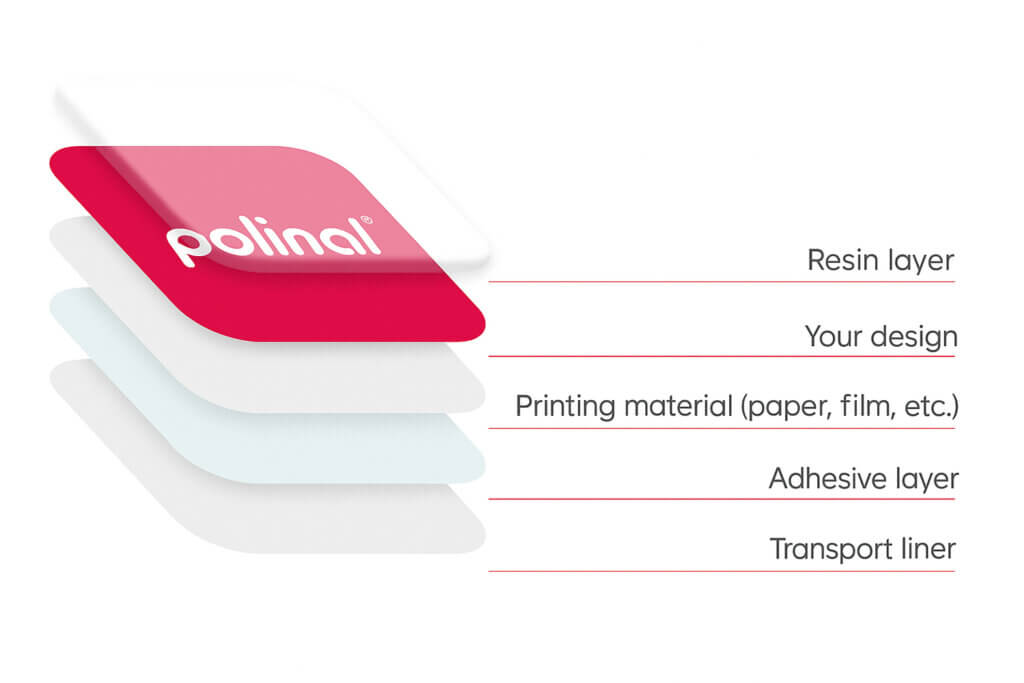
But what exactly is the secret behind this phenomenon? It lies in covering the sticker with a crystal-clear layer of two-component polyurethane resin, dispensed onto a precisely prepared base. The result is a product that not only catches the eye with incredible colour depth (the so-called “lens effect”) but is also virtually indestructible—the resin serves a vital protective function.
In this guide, we explain in detail how 3D stickers are made, why they are so highly valued in marketing, and why doming has become the modern quality standard in professional product branding.

What is doming, and how does the process work?
Doming technology involves the precise dispensing of liquid resin onto a previously printed and cut sticker. Due to surface tension, the substance stops perfectly at the edges, creating a characteristic dome shape. The resulting transparent layer acts as a lens, giving the graphics a near-three-dimensional appearance and a crystal gloss, while also optically enhancing colour saturation.
This method is considered a premium enhancement because it drastically increases the perceived value of a product, turning a simple label into a prestigious emblem with high resistance to external factors. This process creates various types of stickers, from promotional labels for marketing to mass-produced industrial markings.
How are domed stickers made? A step-by-step production process
Understanding how 3D stickers are made allows one to appreciate the precision and technology behind their exceptional durability. The entire process is a multi-stage journey from raw foil to a finished, raised emblem.
Step 1: Selecting the substrate and printing
Production begins with choosing the right base, usually high-quality self-adhesive vinyl: white, silver, gold, or brushed metal effect. Different printing techniques can be used, such as high-resolution digital printing. This is crucial because the subsequent resin layer will act as a lens, highlighting every detail and colour saturation. For very large orders, offset printing or screen printing may be used.
Step 2: Plotting (Cutting to shape)
The printed sheets are sent to precision cutting plotters. It is important for designs to have slightly rounded corners, as this helps the resin flow evenly to the edges. After “kiss-cutting,” the excess waste material is removed (a process known as “weeding”).
Step 3: Application of the polyurethane resin layer
Dispensing machines apply a precisely measured amount of liquid polyurethane resin. Thanks to surface tension, the substance spreads to the edges and stops, forming the transparent dome.

“Only automated production ensures a high standard and consistency. We use Italian DEMAK machines, which offer the highest dispensing precision. Furthermore, using mercury-free resin makes the product more environmentally friendly.” — Sławomir Andrzejewski, Sales Director at POLINAL.
Step 4: Curing and polymerisation
The final stage is curing, which takes place in specialized “clean rooms” free from dust. In controlled temperature and humidity, polymerisation occurs, giving the resin its final hardness and crystal clarity while remaining flexible and resistant to damage.
3D DOMING STICKERS coated with a thin layer of transparent resin – cross section
UV-Resistant Polyurethane Resin: The Heart of Durable Stickers
Unlike cheaper epoxies, polyurethane does not crack or tarnish, guaranteeing years of durability. It is completely resistant to yellowing and features “shape memory,” meaning the surface can self-regenerate after a minor accidental dent.
Key Advantages of Doming Technology
| Feature | Why it matters |
| Weather Resistance | The sticker won’t crack in the frost or fade/yellow in the sun. |
| Mechanical Durability | Protects the print from scratches and chemicals. |
| Prestigious Look | The 3D effect is more eye-catching than a flat label, boosting product aesthetics. |
| Versatility | Can be applied to metal, plastic, and even glass. |
Applications and Types of 3D Stickers
- Equipment Branding: Logos on computers, white goods, electronics, and machinery.
- Automotive: Car emblems and dealership markings.
- Promotional Merchandise: Keyrings, elegant pins, and personalised gifts.
- Industrial Marking: Rating plates resistant to grease and oils.
Why choose POLINAL doming technology?
Choosing doming from the POLINAL Printing House is an investment in a prestigious brand image. Our professionalism is reflected in our rigorous selection of raw materials; we use only high-quality resins that ensure crystal transparency and full UV resistance. Proven polyurethane combined with automated production guarantees consistency and longevity.
Summary
Choosing doming technology is a strategic investment in your brand’s image, which delivers real returns through the exceptional durability and aesthetics of every label. In contrast to standard solutions, the visual effect is flawless. Furthermore, 3D stickers do not fade or deteriorate, ensuring your logo remains intact and continues to catch the eye for many years, building trust with your customers.
Would you like to see how doming technology looks on your products? Please feel free to contact us – our team will be happy to prepare a bespoke quote for you or send free samples, so you can experience the quality of our domed stickers firsthand.