What Is the Difference Between Solvent Printing and Latex Printing?
Printing using solvent or latex techniques is among the most popular methods used in Polish printing houses. Each method has its own advantages and disadvantages and is better suited to different types of print. What characterises each method, and how do these two types differ?

What Is Solvent Printing?
Solvent printing is a popular large-format printing method in which water-based inks are replaced with organic solvent-based pigment inks. These have a significant impact on print durability and increase resistance to UV rays and rain. As a result, the print does not fade or absorb water.
Solvent is primarily used for printing on PVC substrates, especially those that are not receptive to water-based inks. It is one of the modern large-format printing techniques, enabling printing on large, unlimited surfaces.
Solvent printing is ideal for large format printing, including posters, promotional walls (wallpaper), and banners – both internal and external. The prints are made on the large-format solvent printers.
Although its precision is slightly lower than some other methods, the difference is hardly noticeable in large formats. Moreover, solvent printing guarantees excellent colour and contour reproduction.
Promotional stickers – connect with the client

Czym jest druk lateksowy?
W przypadku druku lateksowego stosowane są atramenty na wodne, co zwiększa możliwości wydruku na różnego rodzaju powierzchniach. Druk ten wyróżnia równie wysoka trwałość co druk solwentowy, a ponadto – precyzyjne odwzorowanie szczegółów, jak w druku atramentowym. W efekcie otrzymujemy wyjątkowo wyraziste, odporne na warunki atmosferyczne wydruki.
Druk lateksowy nadaje się do nanoszenia m.in. na folie, np. PCV. Powstają w taki sposób naklejki lateksowe. Ze względu na wykorzystanie farb pozbawionych szkodliwych substancji, tego rodzaju wydruki sprawdzają się idealnie m.in. w szkołach, przedszkolach czy biurach.
What Is Latex Printing?
In latex printing, water-based inks are used, which increases the ability to print on a wide range of surfaces. This method offers durability comparable to solvent printing and, additionally, precise detail reproduction similar to inkjet printing. The result is exceptionally clear, weather-resistant prints.
Latex printing is suitable, among other things, for application on foils such as PVC, producing durable latex stickers. Because the inks are free from harmful substances, this type of printing is ideal for schools, nurseries and offices.
Key Differences Between Solvent Printing and Latex Printing
There are several fundamental differences between solvent and latex printing that can influence your choice. Solvent printing is significantly cheaper – its affordability is one of its major strengths – and offers high resistance to outdoor conditions, ensuring long-lasting prints.
However, due to the solvents in the inks, solvent printing is less environmentally friendly and less safe for human health.
At POLINAL®, we primarily use eco-solvent printing on high-resolution machines. This process is completely safe for people and the environment and offers excellent precision. Latex printing, on the other hand, is an exceptionally ecological option with superior detail and reproduction quality. Its cost is higher, but the precision and durability justify the price.
If you are looking for a cost-effective solution, POLINAL® produces eco-solvent stickers on request – budget-friendly and much more environmentally responsible than traditional hard-solvent prints.
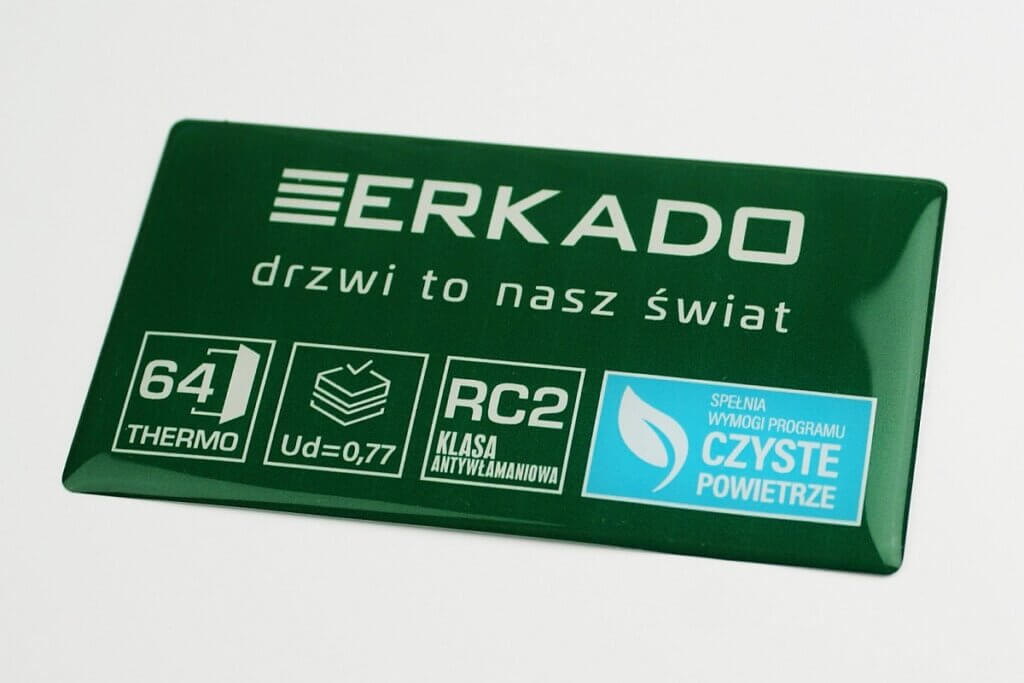
Domed stickers – increase brand visibility!
How Does Solvent Printing Differ From Ordinary Printing?
Digital printing is usually used for projects up to A3+ in size and a maximum sheet thickness of 300 g/m² – for example, brochures, leaflets and business cards.
Large Format Printing
Large-format printing, including solvent printing, offers far greater resistance to weather conditions (especially UV radiation) than ordinary printing. Although the quality is slightly lower, the production cost is also much lower, and because such materials are typically viewed from a distance, the quality difference is negligible.
Types of Solvent Printing
The printing type affects both the print’s durability and the amount of organic solvents contained in the ink. We can distinguish three main types:
- Hard Solvent (Hard Solvent Ink) – The most durable option, ensuring longevity of 3 to 7 years without the need for lamination. Commonly used for truck tarpaulin adverts and vehicle wraps.
- Mild Solvent (Mid-Solvent Ink) – Offers durability of around 2 years and is less toxic than hard solvent ink.
- Eco Solvent (Light Solvent Ink) – Provides up to 2 years’ durability but is completely safe for humans and the environment.
Hard solvent is the most toxic but also the most durable. Mild- and eco-solvent prints are best laminated for additional protection against damage and UV radiation.

Solvent Printing vs Offset Printing
Offset printing is typically used for production materials such as packaging, manuals and labels, as well as marketing materials like business cards, brochures and calendars – usually on paper up to 350 g/m².
Solvent printing, by contrast, is ideal for PVC-based materials. Offset printing becomes cost-effective only for large print runs, whereas solvent printing remains economical even for single or short-run large-format projects.

Promotional stickers – connect with the client
Choosing the Right Printing Technology
The right technique depends on several factors, such as the surface type and the required print quality and durability.
- Solvent printing is ideal for PVC, glass and self-adhesive foil, where high resistance and longevity are needed.
- Latex printing works better on paper and cardboard, where environmental friendliness and the absence of harmful substances are priorities.
Solvent printing is generally more economical for large orders, offering an excellent balance between cost and durability.

Advantages of Solvent Printing Compared With Latex Printing
Solvent printing is more versatile, suitable for diverse surfaces such as PVC, glass, and self-adhesive foil – a key advantage in the advertising industry.
It is also highly resistant to UV radiation and mechanical damage, making it perfect for outdoor use. The technique ensures vivid colours and crisp contours, so prints look excellent both up close and from a distance—an important quality for banners and signage.
Applications of Solvent Printing in Advertising
Solvent printing is mainly used for large-format outdoor materials exposed to varying weather conditions. It is perfect for posters, roll-ups, billboards, city lights and information boards.
Hard solvent printing is particularly effective on mesh materials for outdoor banners, tarpaulins and hoardings. It is also widely used for producing advertising stickers and vehicle decals.
By choosing this method, you can achieve photo-quality prints with deep colour saturation and excellent definition.
What Distinguishes Solvent Stickers?
While a standard office printer handles everyday documents, producing large quantities or large-format stickers requires professional large-format printing.
Solvent printing stands out for its exceptional durability against mechanical damage, temperature changes and weather exposure – it can withstand sunlight, rain and snow for years.
Thanks to its waterproof properties, outdoor stickers can last even longer when laminated. Solvent-printed stickers also offer precise contour reproduction and vivid, lasting colours, all at a reasonable cost – a balance increasingly appreciated by businesses.
At POLINAL®, we produce high-resolution, solvent-printed self-adhesive stickers using state-of-the-art solvent plotters. If you want stickers that attract attention from a distance, thanks to their quality and colour depth, contact us today.
Summary
Solvent printing is a large-format technique in which ink is sprayed onto the substrate, offering superior resistance to external factors compared with latex printing.
Thanks to its UV and mechanical durability, it is perfect for demanding outdoor environments and for use on PVC, glass and self-adhesive foil.
Latex printing, meanwhile, is better suited to paper-based materials where ecological safety is a priority.
Both methods have distinct advantages – the key is to select the technique that best suits your project’s goals, budget and environmental standards.