Do 3D Dome Stickers Yellow?
Yellowing is never something our clients at POLINAL need to worry about. Years of specialist experience in domed sticker production have led us to use exclusively UV-resistant polyurethane resin, and we stand fully behind the long-term clarity of every sticker we make.
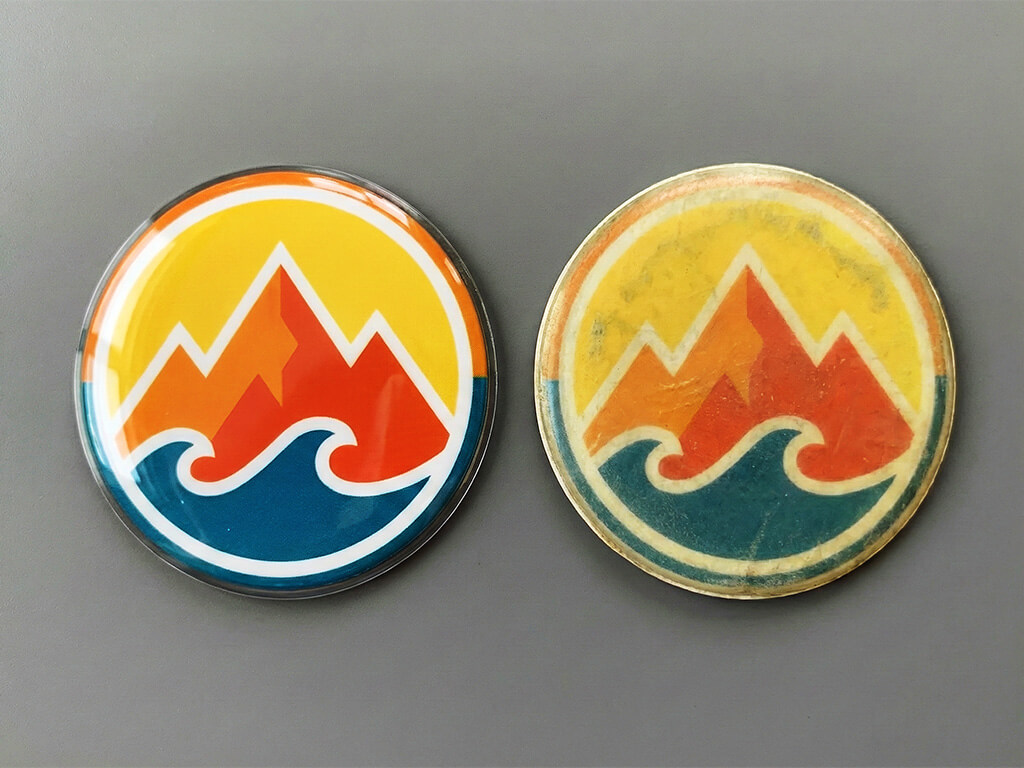
Facts and Myths About 3D Doming Resin.
3D stickers, also known as doming stickers or domed labels, are one of the most impressive forms of product labelling and promotional gadget branding. Their characteristic “glass-like” coating gives logotypes depth and prestige. It protects a company’s logo just like a laminate on flat film stickers, and the appropriate adhesive facilitates quick and easy application whilst ensuring durable adhesion. However, among business owners and marketing departments, a key question frequently arises: do 3D raised stickers yellow over time?
The answer is not straightforward, as everything depends on what the raised layer is made of. In this article we dispel the myths and explain why the quality of the production material is of decisive importance for the aesthetics of your brand.
The Main Myth: “Every 3D Dome Sticker Will Be Yellow After a Year”
This is the most widespread belief, arising from negative experiences with cheap substitutes. The fact is: high-quality raised stickers do not yellow even after many years.
The phenomenon of colour change to an unattractive, honey-like shade is not a “natural ageing process of every sticker,” but rather the result of using incorrect chemical components. If your sticker has changed colour, it means that materials unsuitable for exposure to daylight were used in its production, resulting in yellowed decals.
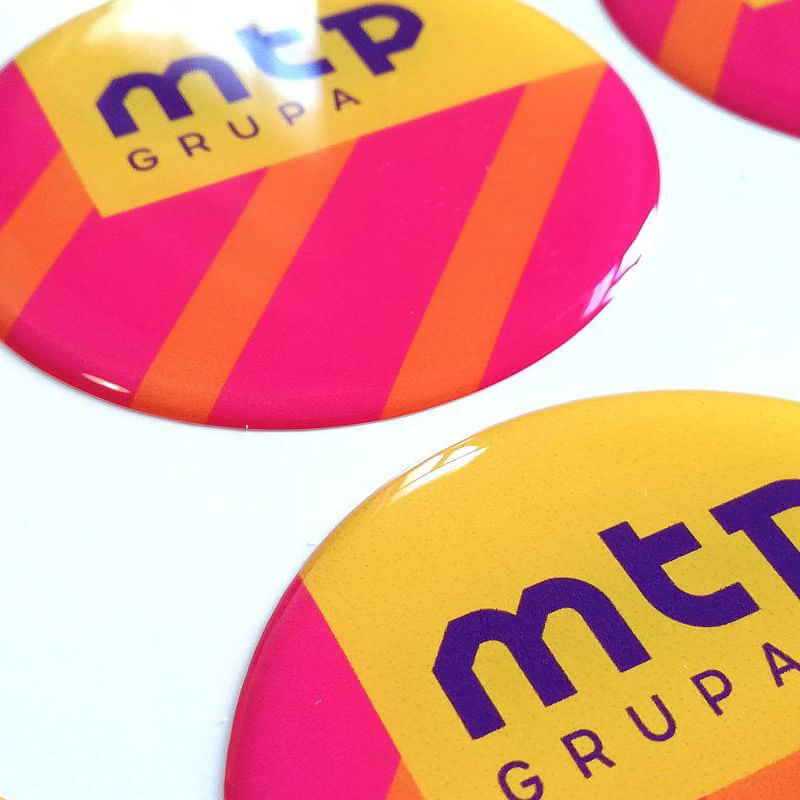
Epoxy Resin vs. Polyurethane (PU) – Where Lies the Difference?
The key to understanding whether 3D stickers yellow is the type of material used. On the market we encounter two main solutions:
Epoxy Resin (susceptible to yellowing)
The resin coating is cheap and easy to process, which tempts many convex sticker manufacturers looking to cut costs. Unfortunately, epoxy resin stickers have very low resistance to ultraviolet radiation, leading to yellowing and degradation of the design. Under the influence of sunlight, the polymer chains undergo degradation, which manifests itself as:
- rapid yellowing of the label,
- loss of elasticity (the sticker becomes hard and brittle),
- Cracking of the gel sticker surface can lead to the formation of yellowed decals.
Polyurethanes (PU) – The Premium Standard in Doming Advertising Technology
This is the only correct choice if durability is important to us. UV-resistant PU polyurethanes are chemically engineered to filter sunlight and maintain perfect clarity and 3D sticker resistance to sunlight is crucial for maintaining their appearance and preventing yellowing. to atmospheric conditions, mechanical damage, abrasion, and both high and low temperatures.
| Feature | Epoxy Resin | Polyurethane Resin (PU) |
|---|---|---|
| UV Resistance | Low (yellowing) | Very high clarity (does not yellow) is a hallmark of quality domed labels. |
| Elasticity | Hardens over time, especially when exposed to the sun. | Always elastic |
| Clarity is essential for high-quality domed labels to ensure they do not yellow over time. | Becomes cloudy | Crystal Clear (crystalline) |
| Application | Indoors only (short-term) use is recommended for decals to prevent turning yellow. | Indoors and outdoors |
Why Is UV Radiation So Harmful For Resin Stickers?
Ultraviolet rays carry a large dose of energy that strikes the molecular structure of the resin. In the case of cheap materials, this energy breaks chemical bonds, resulting in colour change.
The minimum durability of doming stickers made from high-grade polyurethane is estimated at 5 to 10 years, even with constant exposure to sunlight, making them a reliable choice for car’s decals. This is because polyurethane possesses so-called light stabilisers, which absorb “ultra” radiation and disperse it in the form of harmless heat, ensuring the longevity of the design.
How to Check Whether a Sticker Will Yellow in the Future?
If you are planning an order, you can carry out a simple test or ask the mmanufacturer-specific questions:
- Ask for the material safety data sheet: Make sure the manufacturer uses exclusively the polyurethane (PU) version.
- Hardness test: If you receive a sample to test the 3D stickers, try gently pressing your fingernail into it. PU polyurethane is elastic, pleasant to the touch, and should return to its original shape after a moment (so-called shape memory). Epoxy resin often feels as hard as plastic – this is a warning sign. It cannot be used at higher ambient temperatures.
- UV guarantee: Professional sticker printers have no difficulty in providing a guarantee against colour change of the coating, ensuring your car’s decals remain vibrant.
Summary
If you are wondering whether 3D stickers yellow under the influence of light, the answer is: those of good quality – no; they maintain their vibrant design. When choosing sticker production, do not be guided solely by the lowest price, as the difference in costs usually arises from the use of epoxy resin instead of polyurethanes, which can affect the final design. Investing in PU polyurethanes is a guarantee that your logo will remain clear and aesthetically pleasing for years.
FAQ – The Most Frequently Asked Questions for a Sticker Producer
-
Does polyurethane resin act as a laminate?
Just as a laminate protects sheets of flat stickers, polyurethanes protect the print in a number of ways. The application technology is different. Laminate is usually applied by adhering it to the print, whereas polyurethanes are dispensed onto sheets by machine in liquid form. The protective effect is similar. Prints do not fade under the influence of ultraviolet radiation. However, the visual effect is entirely different. A sticker in the laminate version does not have a 3D effect and does not present itself as attractively as raised resin stickers.
-
Will PU polyurethane also protect the print against fading?
es. The ability of a resin sticker to reflect UV rays has an enormous influence on the fact that prints do not fade or yellow. High exposure of advertising stickers to sunlight and other harsh conditions can degrade the print itself if it is protected only by epoxy resin. Only a label with high resistance to atmospheric conditions and ultraviolet radiation, made from transparent polyurethane resin, retains vivid print colours throughout its lifetime.
-
Does the colour of the print beneath the raised dome affect the yellowing of the surface under the influence of light?
The colour of the print on the film itself does not affect the coating material, but on yellowed resin the white and light elements of the artwork will suffer the most — these are where you will notice the quality problem first. It is worth bearing in mind that even crystalline, colourless polyurethanes slightly alter the shade of the colours in a design printed on a flat sheet of film, lightly brightening the print. This is a matter of the 3D effect — the refraction and reflection of light from the 3D lens. This effect is not noticeable in the case of flat stickers without a 3D layer on the film.
-
Can the 3D effect be salvaged in a gel sticker that has already yellowed?
Unfortunately not. The colour change is a process of chemical degradation within the epoxy polymer. The only solution is to replace the sticker with a new one made from UV-resistant polyurethane.
-
Do 3D resin stickers yellow from smog or cigarette smoke?
External pollutants may settle on the surface of a raised label, forming a dirty residue, but they do not alter the structural properties of the material surface. They are easy to clean. Simply wiping the sticker with a soft cloth and water is sufficient to restore its lustre.