How to Recognise Good 3D Logo Stickers: 5 Features of a Durable Finish and Print
A good 3D logo sticker is identified by five things: an optically clear dome cast in aliphatic polyurethane rather than epoxy, a resin soft enough to recover from a fingernail press, an adhesive matched to the surface it will live on, a clean meniscus that stops exactly at the cut edge, and an interior free of bubbles and dust. Every one of those can be checked on a sample in under a minute, without equipment. The difficulty is that a cheap dome and a premium dome look almost identical on the day they arrive. The difference appears after a winter outdoors, which is why the checks below matter before the order is placed rather than after.
This guide covers assessment and quality control. It does not repeat how domed stickers are manufactured, which is set out in the complete guide to 3D domed stickers, nor the full resin comparison, which is covered separately in POLINAL’s article on polyurethane and epoxy doming.
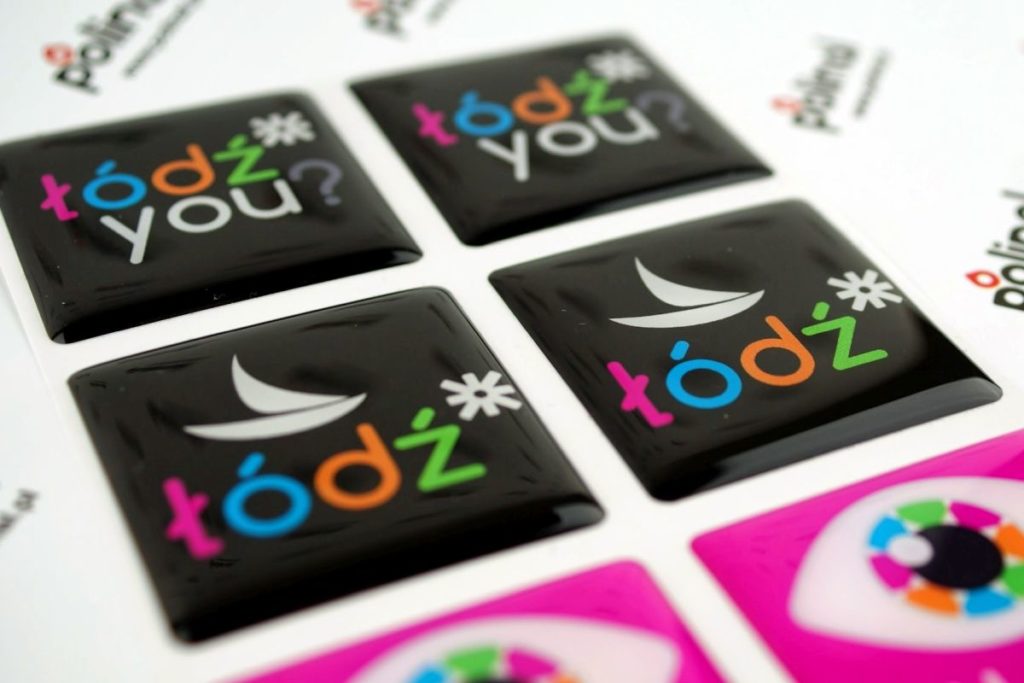
1. Optical Clarity That Survives Sunlight
The dome should read like a pane of glass, with no haze and no amber cast. Yellowing is the single most common failure in this product category, and it is not a matter of luck. It is chemistry, and the chemistry is predictable enough to specify in advance.
Polyurethane resins are built from isocyanates. Aromatic isocyanates such as MDI and TDI contain benzene rings, and under ultraviolet light those rings photo-oxidise into quinone-type structures. Quinones absorb blue light, so the eye reads what remains as yellow. Aliphatic isocyanates have no aromatic ring, so that reaction pathway does not exist, which is what the phrase “non-yellowing resin” actually means. The mechanism was documented by Rosu and colleagues in Polymer Degradation and Stability in 2009.
Epoxy behaves differently and, for outdoor branded stickers, worse. Epoxy yellows through thermo-oxidation, forming carbonyl groups in the polymer backbone. Heat alone drives it, so an epoxy dome can go amber in a warehouse or on a machine casing with no direct sun at all, and research on epoxy ageing reports that the colour change is irreversible once those chromophores have formed. No polish or cleaner reverses it.
The practical consequence is a single question worth putting to any supplier: is the resin aliphatic polyurethane, and can that be confirmed in writing? A vendor who answers “polyurethane” without the word aliphatic has not answered the question.
2. Flexibility You Can Measure: Shore Hardness and Shape Memory
Good dome stickers are soft. This is functional rather than cosmetic, because a flexible lens follows a curved substrate such as an electronics housing, a helmet shell or a bodywork panel, and it absorbs impact instead of fracturing.
Flexibility has a number attached to it, and buyers rarely ask for it. Doming resins are sold on the Shore scale: soft grades are quoted in Shore A and are intended for curved surfaces, hard grades in Shore D for flat nameplates. Transparent doming polyurethanes are typically formulated in the Shore A 70 to 85 band, with harder Shore D variants available where a rigid plate finish is wanted. Requesting the Shore value on the technical data sheet converts a marketing adjective into a specification.
Shape memory follows directly from that hardness. A crosslinked polyurethane elastomer is entropically driven back to its original geometry after deformation, so an indentation relaxes out within seconds. A brittle, highly crosslinked epoxy has no such recovery, and the mark stays. That is why the fingernail test described further down works at all, and it is also why a permanent dent is a reliable warning of a material that will scratch, dull and eventually crack.
“At POLINAL, we believe that a printed and domed 3D sticker is not merely a unique promotional item, but above all a durable, weatherproof ambassador for a brand. That is why we never compromise on raw materials. The exclusive use of aliphatic polyurethane resins in our print works is our standard, because only these give us confidence that a company’s logo will look exactly the same on the day of delivery as it will after five years of exposure to sun or rain. Cheap epoxy alternatives simply do not stand the test of time.” Andrzej Łukomski, Owner, POLINAL
3. Adhesive Matched to the Surface
An immaculate lens is worthless if the label lifts at the edge after a month. Domed stickers carry considerably more mass than flat vinyl stickers, and that mass works against the bond every time the substrate flexes or the temperature swings. Standard promotional vinyl frequently cannot hold it, and the symptom is always the same: corners rising first, then a visible gap around the rim.
Quality shows as an immediate, firm grab from the first second of application, with no creep under heat. The relevant variable is surface energy. Powder-coated metal, painted steel, ABS and polypropylene each demand a different adhesive, and low surface energy plastics in particular need a high-tack or extra-tack formulation rather than a general purpose one. A supplier who asks what the custom sticker will be applied to before quoting is doing the job properly. A supplier who offers one adhesive for everything is not.
4. Edges, Meniscus and Dispensing Consistency
Finish quality is judged at the perimeter. Dispensed resin should spread under its own surface tension and stop precisely at the cut edge of the vinyl, forming a full, evenly domed meniscus over the shape, whatever that custom shape happens to be. Two defects dominate when this goes wrong. Under-filling leaves flat, dull areas where the resin never reached the corners. Overflow lets the liquid creep past the outline onto the backing.
The pattern of the defect identifies its cause, which is useful when assessing a sample sheet. If every unit on the sheet is under-filled, the dispensed volume is simply too low. If every unit overflows, the volume or the target dome height is too high. If under-fill and overflow appear at random across the same sheet, the problem is mechanical: sheet flatness, nozzle height or dispensing calibration drifting during the run. If only certain shapes fail, the cause is geometry, with sharp corners and tight radii being the usual offenders.
The test to apply is therefore consistency rather than perfection on one unit. A properly produced run shows the same meniscus height on every sticker, which is achievable only with precision dispensing equipment held at stable temperature. POLINAL uses DEMAK dispensing machines for this reason.
5. A Clean Interior: No Bubbles, No Dust
The dome magnifies whatever sits beneath it, so a fibre that would be invisible on a flat label becomes an obvious flaw once a 1.5 mm lens is over it. Premium production takes place in controlled, low-dust conditions precisely because contamination cannot be removed after curing.
Bubbles are the more diagnostic defect, because their timing reveals the process fault. Bubbles present immediately after dispensing come from air entrained during mixing, from air in the cartridge or mixer, or from dispensing too quickly. Bubbles that appear hours later, once the resin has begun to set, point at moisture: either ambient humidity reacting with the polyurethane or solvent outgassing from print that was covered before it had fully dried. Industry guidance for doming operations recommends keeping relative humidity below 40 per cent during application for this reason.
A finished premium surface should be mirror-uniform, with no rippling under raking light and no visible particles at any viewing angle.
Premium Versus Budget Production Compared
| Feature | Premium production (POLINAL) | Budget production |
|---|---|---|
| Resin chemistry | Aliphatic polyurethane, no aromatic ring to photo-oxidise | Epoxy or unspecified aromatic polyurethane |
| Reaction to UV and heat | No visible colour shift over years outdoors | Irreversible yellowing, sometimes within months |
| Hardness declared | Shore value stated on the data sheet | “Flexible” claimed, no number given |
| Response to indentation | Elastic recovery within seconds | Permanent dent or micro-cracking |
| Adhesive | Selected against the substrate and its surface energy | One universal adhesive for all applications |
| Meniscus consistency | Uniform across the whole run | Under-fill and overflow mixed within one sheet |
| Weathering evidence | Test data available on request | Unverifiable durability claim |
Two Sample Tests a Buyer Can Run Without Equipment
Both tests below take seconds and need nothing but a sample sticker. They separate polyurethane from epoxy more reliably than any product description does.
Test 1: the fingernail test, for shape memory
Polyurethane is an elastomer and recovers its shape. Epoxy is a rigid thermoset and does not.
- Method: press the edge of a fingernail firmly into the centre of the clear lens and hold for two to three seconds, long enough to create a visible indentation.
- Premium result: the indentation starts to disappear almost immediately and the surface is perfectly smooth again within seconds, with no trace of the pressure.
- Budget result: a sharp indentation remains, or the resin crazes around the pressure point. That is hard, brittle material, and it will dull and scratch quickly in service.
Test 2: the flex test, for elasticity and lamination
A dome must move with its substrate, particularly on plastic and metal parts that expand when heated.
- Method: take the sheet of stickers and roll it gently in the hand, or peel off a single unit and try to fold it lightly.
- Premium result: the sticker bends smoothly with a soft resistance, similar to firm rubber. The resin stays fully bonded to the vinyl throughout, with no air pockets and no lifting at the rim.
- Budget result: an audible crackle, stiff resistance, or the resin beginning to separate from the backing. Such a sticker will crack or debond within a short period of outdoor use.
“In my relationships with our business partners, I often emphasise that a 3D label is not a cost, it is an investment in the trust of the end customer. We frequently encounter companies who, tempted by savings of a few pence per unit, opt for cheap alternatives, only to find themselves dealing with mass complaints and reputational damage a few months later. At POLINAL, we do not simply sell stickers, we deliver the assurance that the logo on your product will serve as an impeccable brand ambassador for years, regardless of the conditions in which it operates. It is the cheapest and most effective insurance policy for your brand’s image.” Sławek Andrzejewski, Sales Manager, POLINAL Print Works
What to Ask a Supplier Before Ordering
Four questions separate a documented product from a confident sales claim. Each has a verifiable answer.
- Is the resin aliphatic polyurethane? The word aliphatic is the one that matters, and it should appear on the technical data sheet.
- What is the Shore hardness? A Shore A figure indicates a flexible dome suited to curved parts; Shore D indicates a rigid plate finish.
- Has colour stability been tested to ISO 4892-2? That standard covers xenon-arc exposure of plastics, simulating the full solar spectrum rather than ultraviolet alone, and it is a far stronger answer than an unsupported “five year” promise.
- Which adhesive is specified, and for which substrate? The correct answer names the surface. A single universal adhesive is a warning sign.
Anyone specifying 3D domed stickers for a product line can raise all four at quotation stage, and the quality of the answers is itself informative. A custom sticker order is easier to compare on those four points than on price per unit alone.
Print and Cutting Quality Beneath the Dome
The resin protects the print, but it also magnifies every fault in it. Assessment of domed self-adhesive labels therefore has to include the print stage. Modern digital printing and solvent printing each produce a different result on vinyl, and the outcome is decided earlier still, at artwork preparation: colour profiles matched and verified, resolution and typefaces checked, and adequate spacing left between the artwork and the anticipated cut line.
Cutting is the stage most often underestimated. Plotting or die-cutting the printed sticker sheets defines the outline, and it is what allows die cut stickers to be produced in any custom shape. Poorly calibrated equipment produces registration drift between print and cut, and once the polyurethane layer is on top, that misalignment is magnified and permanent. An ideal sticker is printed and cut to the design within a tenth of a millimetre, consistently across the whole run. The same criteria apply when judging paper stickers, where the cut line is equally unforgiving even without a dome over it.
POLINAL provides custom sticker printing together with full artwork preparation, so the sticker material, cut line and resin are specified as one job rather than three. Treating label printing and doming as a single printing service, rather than subcontracting the dome to a third party, removes the registration errors that appear when a custom label passes between two workshops.
Personalisation Within a Print Run
Personalised sticker production is worth raising at the briefing stage, because it is not universally offered. Individual numbering, barcodes, serial data and artwork variants for different product lines can all be carried within a single run of branded stickers, and a supplier that can print stickers with variable data in one pass avoids the cost of splitting the job into short runs. Being able to include that personalisation in an order for logo stickers, in any shape and size, is one of the features that distinguishes POLINAL as a supplier of stickers and labels.
Frequently Asked Questions
How quickly do cheap domed stickers start to yellow?
There is no fixed interval, because the rate depends on ultraviolet dose, ambient temperature and the specific formulation. What is predictable is the direction. An aromatic polyurethane or epoxy dome placed in direct sun will shift towards amber and will not come back, whereas an aliphatic polyurethane dome has no aromatic ring available to form the chromophores responsible. Where a service life must be evidenced rather than estimated, accelerated weathering data to ISO 4892-2 is the appropriate request.
Does a strong chemical smell indicate a quality problem?
It can. A pronounced chemical odour on opening the packaging suggests curing was not fully completed before dispatch, and an under-cured dome stays soft, marks easily and bonds poorly. Fully cured domed stickers have very little smell.
Can a domed sticker be applied to a curved surface?
Yes, within limits, and this is where the Shore value earns its place. A dome in the Shore A range will follow a gentle convex curve such as a helmet or a machine housing. A hard Shore D dome will bridge and lift at the edges on the same part. The radius of the surface should be stated when requesting a quotation.
Are domed stickers suitable for outdoor and industrial use?
Aliphatic polyurethane domes are designed for it, and they are widely used on machinery, vehicles and equipment exposed to weather, cleaning agents and temperature cycling. The failure point in outdoor service is more often the adhesive than the resin, which is why the substrate should be identified before the specification is fixed.
How does a buyer compare two suppliers fairly?
Order a sample from each, run the fingernail test and the flex test on both, then compare their answers on resin chemistry, Shore hardness, weathering data and adhesive selection. Two sample stickers cost nothing and expose differences that a specification sheet can conceal. A free sample pack from POLINAL is available for exactly this comparison, with UK delivery included.
Summary
Choosing 3D self-adhesive stickers is a decision about how a brand will look in three years, not on delivery day. Aliphatic polyurethane resin, a declared Shore hardness, an adhesive chosen against the substrate, well-prepared artwork and consistent dispensing are the five variables that decide the outcome, and four of them can be verified in a sample or on a data sheet before any money is spent. Time is a ruthless judge of material quality, and the fingernail test anticipates its verdict in about three seconds.
Frequently Asked Questions about stickers quality
-
How does a buyer compare two suppliers fairly?
Order a sample from each, run the fingernail test and the flex test on both, then compare their answers on resin chemistry, Shore hardness, weathering data and adhesive selection. Two sample stickers cost nothing and expose differences that a specification sheet can conceal. A free sample pack from POLINAL is available for exactly this comparison, with UK delivery included.
-
Can a domed sticker have a matte finish?
Standard doming resins cure to a high gloss, and that gloss is functional rather than decorative. It is what creates the lens, the visible depth and the magnification of the print beneath. Matte and satin doming resins do exist, but they are typically described as semi-gloss to satin with a hazier clarity, so specifying one gives away part of the effect that justifies doming at all. Where a matte appearance is required, a flat label with a matte laminate normally serves better than a matte dome. Where gloss is wanted, judge it as in check one: clear and colourless, never milky.
-
Should domed stickers be kiss-cut or die-cut?
Kiss-cut for most domed work. Kiss-cutting cuts the printed film but leaves the backing paper intact, so the units stay together on a sheet, and that matters because the resin is dispensed after cutting: the liquid spreads and stops at the cut edge by surface tension. An intact backing also makes dispensing faults visible, since overflow shows up as resin creeping onto the liner around the outline. Die-cutting goes through the backing as well and gives separate pieces, which suits application line by line. In either case, check the registration between print and cut before the dome goes on, because the resin magnifies any drift and nothing can be corrected once it has cured.
-
Does a strong chemical smell indicate a quality problem?
It can. A pronounced chemical odour on opening the packaging suggests curing was not fully completed before dispatch, and an under-cured dome stays soft, marks easily and bonds poorly. Fully cured domed stickers have very little smell.
-
How quickly do cheap domed stickers start to yellow?
There is no fixed interval, because the rate depends on ultraviolet dose, ambient temperature and the specific formulation. What is predictable is the direction. An aromatic polyurethane or epoxy dome placed in direct sun will shift towards amber and will not come back, whereas an aliphatic polyurethane dome has no aromatic ring available to form the chromophores responsible. Where a service life must be evidenced rather than estimated, accelerated weathering data to ISO 4892-2 is the appropriate request.
Have a question? We’re here to help
Sources
The chemistry and testing claims above are drawn from peer-reviewed polymer degradation research, the published ISO catalogue entry for the relevant weathering standard, and technical documentation from doming resin manufacturers. Supplier marketing pages were not used as evidence for any technical figure. The two sample tests are POLINAL’s own quality-control practice, described here as they are applied in the print works.
- Rosu, D., Rosu, L., Cascaval, C. N., IR-change and yellowing of polyurethane as a result of UV irradiation, Polymer Degradation and Stability, 2009. Documents the photo-oxidation pathway behind yellowing in polyurethane.
- Yellowing mechanisms of epoxy and vinyl ester resins under thermal, UV and natural aging conditions and protection methods, Polymer Testing, 2022. Sets out the thermo-oxidative route to yellowing in epoxy systems.
- Mechanism of yellowing: carbonyl formation during hygrothermal aging. Links carbonyl group formation to irreversible colour change.
- ISO 4892-2:2013, Plastics: methods of exposure to laboratory light sources, Part 2: xenon-arc lamps. The accelerated weathering standard referenced above.
- Incure, doming resin industrial guide. Source for the Shore A and Shore D grade distinction and the sub-40 per cent humidity recommendation during application.