The Marketing Mix: Understanding the 4 Ps of Marketing
Marketing mix, also known as the 4 Ps of marketing, is a fundamental tool used by marketers to strategise and implement their activities.
The marketing mix concept is a key theoretical marketing model that helps brands influence their market environment. In the context of product marketing, we can distinguish the following elements of the marketing mix:
- Product
- Price
- Promotion
- Place
The 4P marketing mix allows for a comprehensive approach to planning marketing activities. What exactly is the 4P marketing formula, and what does it consist of?a?

The history and importance of the 4 Ps of marketing
The idea of the 4P formula originated in the mind of Professor E. Jerome McCarthy, who introduced it to the world in the 1960s. Since then, this principle has become a cornerstone for marketers worldwide, enabling them to plan and execute effective marketing strategies.
Over the decades, despite dynamic market changes and the emergence of new technologies, the 4P principle has evolved, adapting to new conditions and consumer needs. Currently, although the basic elements—Product, Price, Promotion, and Distribution—have remained unchanged, the way they are interpreted and implemented is more complex and diverse than ever before.
Domed stickers – increase brand visibility!
Marketing mix modifications 4Ps – 4 Cs, 7 Ps
Marketing mix elements, such as the 4Ps, 7Ps, and 4Cs, work together to create marketing strategies tailored to customer needs and influence the success of marketing campaigns.
Creating a product that is available at the right time and place, at a reasonable price, and promoted through well-thought-out channels is a key element of the traditional 4P marketing mix.
This flexibility and versatility mean that the 4P marketing mix continues to play a key role in creating effective marketing strategies. The 4P formula serves as the axis around which all marketing strategies revolve, enabling the understanding and meeting of market expectations. Its application allows companies not only to reach their customers effectively but also to build a lasting competitive advantage.
Marketing mix in different industries
The 4P marketing mix has various applications in many industries, from technology to catering services, adapting to the specific needs of each and the target customer group. Marketing elements, including product, price, place, and promotion, play a key role in creating effective marketing strategies.
In the e-commerce sector, it is becoming crucial to use effective online distribution and promotion to reach a wide range of consumers. In the fashion industry, product uniqueness and effective pricing strategies are essential for differentiating oneself from the competition and capturing the attention of customers seeking originality.
What are the Four Ps Of Marketing?
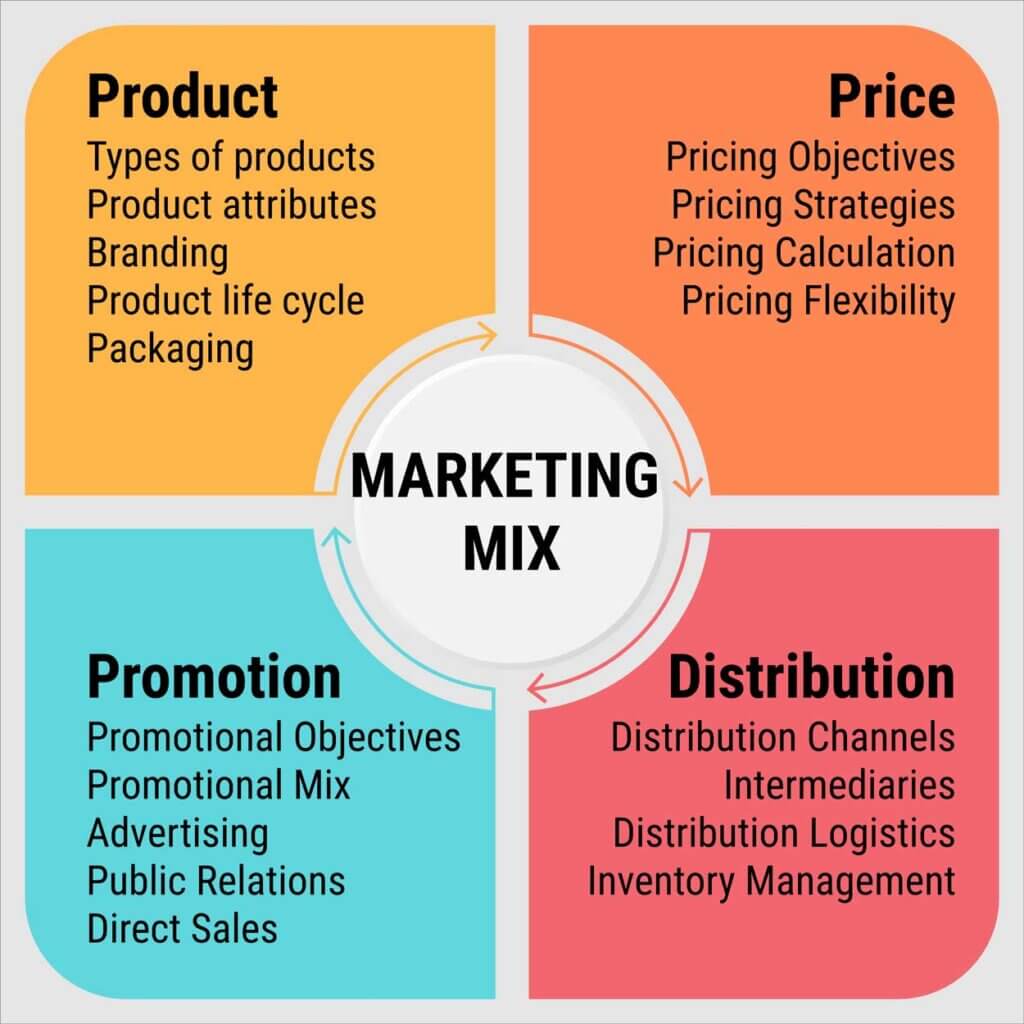
The 4P formula, also known as the marketing mix, is a concept based on four fundamental elements: Product, Price, Promotion and Place. The key assumption of this strategy (marketing plan) is the optimal adaptation of these four components to meet the market’s needs and customers’ expectations.
Implementing the 4P principle requires in-depth market analysis and an understanding of the target audience to manage each element effectively. The correct combination and application of the components in this mix are crucial for a company to achieve its marketing goals and gain a competitive advantage in the market.

Promotional stickers – connect with the client
Elements of the marketing mix
The 4P marketing mix consists of four key elements:
Product
The first step is to create a product – you need to identify the features and properties of the product that distinguish it from the competition and tailor its offer best to meet the needs of potential consumers (customers). Customer interest in the product is the first stage of the marketing mix concept.
When focusing on the product, you need to pay attention to, among other things, its quality, recognition, packaging and features that distinguish it from the competition. When marketing a product or service, it is important to pick a price that is simultaneously accessible to the target market (especially for a new product) and meets a business’s goals.
Price
Price is the amount that potential customers are willing to pay for a product or service. Price is one of the main competitive factors. There are different pricing strategies; setting a Price requires analysing costs, evaluating competitive prices, and understanding the value that the product brings to the customer’s life.
Promotion
Promotion refers to the sales promotion. It involves developing a communication strategy (public relations) and utilising suitable channels (e.g., social media, online advertising) to target potential buyers and encourage them to make a purchase. It is also worth noting that content marketing is a key element of modern marketing strategies, enabling the creation of valuable content that meets customer needs.
In the case of promotions, it is worth focusing on methods that will increase sales and help maintain a given product on the market, taking into account various forms of advertising, such as advertising gadgets inside promotional activities.
POLINAL offers customised advertising solutions created for individual companies. They are exceptionally effective promotional tools – both for the whole brand and the products they provide. Gadgets work well for basic marketing and help build brand awareness for a product or service.
Place
The last element, Place (distribution), involves planning the distribution of the product so that it is easily accessible to the target customer group. Direct sales enable direct contact between the seller and the customer, which is crucial for building relationships and understanding customer needs. In this area, an effective distribution strategy should be created, including logistics.
Thanks to this strategy, the product offering will be available to customers at the right place, at the right price, and at the right time. Promotion tools: The 21st century – e.g., the Internet – allows for intensive development in this area.
The 4C Concept in Marketing Mix
The 4Cs concept in the marketing mix is an approach that focuses on the customer’s perspective. It was proposed by Robert Lauterborn in 1990. The 4Cs concept consists of four marketing objectives: Customer, Cost, Communication and Convenience.
Customer
In the 4C concept, the customer is the central element. This means that the company should focus on the needs and expectations of its customers, rather than its own goals. Understanding what is essential to customers enables the company to tailor its offerings to their needs, which in turn enhances customer satisfaction and fosters brand loyalty. In practice, this means that companies must conduct market research, analyse data and communicate directly with customers to understand their needs and expectations better.

Dome 3D stickers – make your brand stand out!
Cost
Cost in the 4C concept refers to the total cost that a customer incurs to purchase a product or service. This is not only about the purchase price, but also about other expenses, such as time, effort, or costs associated with using the product. The company should set the price in a way that is attractive to customers while also ensuring a profit. The cost must be aligned with the quality of the product or service, enabling the creation of value in the customer’s eyes.
Communication
Communication in the 4C concept refers to how a company communicates with its customers. Unlike traditional promotion, communication is two-way and interactive. A company should utilise various forms of communication, including social media, advertising, and PR, to effectively reach customers and capture their attention.
Effective communication is about building relationships with customers, listening to their opinions, and adapting the message to their needs and expectations. This approach is essential in today’s competitive landscape, where understanding the target audience can significantly influence the success of a marketing strategy.
By engaging in two-way conversations, businesses can gather valuable insights that help tailor their offerings, ensuring that customers feel heard and valued. As a result, the marketing mix 4P—product, price, place, and promotion—can be effectively aligned with customer preferences, enhancing overall satisfaction and loyalty.
Convenience
Convenience in the 4C concept refers to how a company delivers its products or services to its customers. A company should ensure that its products or services are available in a manner that is convenient for customers, such as online, in-store, or through direct sales.
Convenience also encompasses ease of purchase, access to product information, and post-sales service. Meeting customers’ convenience preferences can significantly impact their experience and satisfaction.
The 4C concept in the marketing mix is crucial because it enables companies to understand the needs and expectations of their customers and tailor their offerings to meet those needs. This allows the company to enhance its marketing effectiveness and achieve its objectives. In today’s dynamic market environment, understanding and meeting consumer expectations is the key to success.
Promotional stickers – connect with the client

Examples of effective use of the 4 Px marketing mix campaigns
Uber – a transportation service
- Product: Innovative transport service based on a mobile application.
- Price: Flexible pricing strategy based on supply and demand, and focuses on perceived value for the customer.
- Distribution: Online platform and mobile app, ensuring broad reach.
- Promotion: Viral marketing, social media campaigns, and affiliate programs.
- Result: Success in the global market and domination in the ride-hailing segment.
Spotify – Online Service
- Product: Music streaming platform offering a wide selection of songs and features.
- Price: Various subscription models to suit different user needs.
- Distribution: Online platform and mobile application, integration with other platforms and devices.
- Promotion: Content marketing, social media influencer campaigns, and free subscription plans.
- Result: Success of the marketing strategy and product on the global market, leader in the music streaming segment.
Examples of ineffective 4 Ps marketing mix campaigns
Segway – a physical product
- Product: Futuristic electric scooter with an innovative design.
- Price: The high price is prohibitive for many potential customers.
- Distribution: Limited availability at select retail stores.
- Promotion: The lack of a coherent marketing and promotional strategy, with a focus on technology rather than user benefits.
- Result: Low sales, unmet customer expectations, and product withdrawal from the market.
Google Glass – a physical product
- Product: Innovative AR glasses with functions for displaying information and interacting with the environment.
- Price: High price is prohibitive for most consumers.
- Distribution: Limited availability in select Google stores.
- Promotion: Focuses on technology and futuristic design, but lacks a clear message about the benefits for the user. Low effectiveness of marketing activities.
- Result: Low sales, unmet customer expectations, project abandonment.
Advantages and disadvantages of the marketing mix 4 Ps
The advantage of the 4P Principle is its universality and the possibility of application in almost every industry. It provides a comprehensive view of the company’s marketing strategy, integrating key aspects such as product, price, promotion, and place. Thanks to this, companies can better adapt their activities to the market’s needs and the target group’s expectations, implementing them within an effective marketing strategy and increasing sales.
The disadvantage of this principle, however, is its relative simplicity, which may overlook all the factors that affect a product’s market success in the rapidly changing digital world. The 4P marketing approach can also be perceived as overly rigid, limiting creativity and innovation in marketing strategies.
The importance of the 4 Ps marketing mix in modern marketing and customer expectations
In modern marketing, the 4P formula remains a crucial component, particularly in product and service marketing, where its effective application helps coordinate all elements of the strategy. Companies that effectively integrate the 4P into their digital strategies are better able to understand and meet the expectations of their customers.
Personalisation of the offer, a flexible approach to pricing, creative forms of promotion and intelligent product distribution and after-sales service are now possible thanks to data analysis and advanced marketing tools.
Directions of development of the 4P marketing mix concept
Extending Marketing 4P to 7P
Extending the traditional 4P principle to the 7P marketing mix in modern marketing opens up even wider possibilities for companies to build effective strategies.
The 7P marketing mix is an extended concept of the traditional 4P marketing model, emphasising the importance of seven key elements in developing effective marketing strategies. People, processes and physical evidence now join Product, price, promotion and place. The seven Ps include the processes that define the customer experience and the physical evidence that the target market needs to see to become customers. Not only are the seven Ps applicable to traditional marketing, but they are also effective and useful insights for digital marketing in the modern age.
In the digital era, where customer interaction often takes place at a distance, people are gaining immense importance in an effective marketing strategy, as well as in customer service and advisors who can personalise the offer and adapt it to the individual needs of each customer. This affects the positive customer experience and allows you to meet consumer expectations.
Processes are becoming key to effectively managing operations and delivering value continuously and coherently. At the same time, physical evidence, although it may seem less important in the virtual world, still plays a role through reviews, user testimonials, and online product presentations. These additional elements enable a more comprehensive and detailed understanding of market needs, facilitating the development of long-term relationships with customers.
Virtual world – Internet and social media
The development of information technology also introduces a new concept of the marketing mix, especially because of different distribution channels. The point of sale is no longer limited to physical stores or offices, but also includes virtual spaces such as websites, e-commerce platforms, and social media, which are the basis for a new successful marketing strategy.
In the case of “Promotion”, tools such as word-of-mouth marketing, influencer marketing, content marketing, and other public relations activities, as well as personalisation of communication, are becoming the standard for reaching the recipient.
As a result, we can observe the transformation of the 4P principle into a more comprehensive approach to the 7P marketing mix, or even the marketing mix, where additional elements such as people, processes, or efficiency are a response to the dynamically changing requirements of both the market and consumers themselves. The 7 Ps framework is a powerful tool for developing effective marketing communication strategies, utilising promotional channels, and measuring the success of promotional campaigns.
Striving for excellence in each of these areas allows companies not only to remain competitive but also to build lasting and valuable relationships with customers. Companies must also integrate multiple marketing channels, such as content marketing, email marketing, and social media marketing. to reach a wider audience and reinforce their campaign message.
FAQ – Frequently Asked Questions
-
How has the traditional 4 Ps model evolved to meet digital age requirements?
The traditional 4 Ps have evolved into the 7 Ps marketing mix, adding People, Processes, and Physical Evidence to address modern marketing challenges. In the digital era, People have become crucial for customer service and personalisation, Processes are key for managing operations and delivering consistent value, and Physical Evidence includes online reviews and testimonials that build trust. Additionally, distribution channels now include virtual spaces like websites, e-commerce platforms, and social media, while promotion has expanded to include influencer marketing, content marketing, and personalised communication strategies that reach customers through multiple digital touch points.
-
What are some common reasons why marketing mix strategies fail, as shown in real-world examples?
Marketing mix strategies often fail when companies focus too heavily on innovative technology rather than customer benefits, as seen with products like Segway and Google Glass. These failures typically involve setting prohibitively high prices that exclude the target market, having limited distribution channels that restrict product availability, and lacking coherent promotional strategies that clearly communicate value to users. The key lesson is that even innovative products can fail if the marketing mix elements don’t work together to address real customer needs and provide accessible solutions.
-
How does the modern 4C concept differ from the traditional 4 Ps approach?
The 4C concept, proposed by Robert Lauterborn in 1990, shifts focus from the company’s perspective to the customer’s perspective, replacing Product with Customer needs, Price with Cost to customer, Promotion with Communication, and Place with Convenience. While the 4 Ps focus on what companies want to sell, the 4 Cs emphasize understanding what customers actually want to buy and how they prefer to interact with brands. This customer-centric approach enables two-way interactive communication and helps companies better tailor their offerings to meet specific customer needs and expectations.
-
What exactly are the 4 Ps of marketing and why are they still important in modern business?
The 4 Ps of marketing are Product, Price, Promotion, and Place, which form the fundamental marketing mix concept introduced by Professor E. Jerome McCarthy in the 1960s. This framework remains important because it provides a comprehensive approach to planning marketing activities and helps companies strategically influence their market environment. Despite dynamic market changes and new technologies, the 4 Ps have evolved and adapted to modern conditions while maintaining their core effectiveness in helping businesses understand and meet market expectations.