AIDA Marketing Model
AIDA is one of the most effective models for building marketing strategies that help many consumers make purchasing decisions. The AIDA model is highly effective in activities that aim to attract attention and convince the consumer to our product or service, especially in digital marketing. For your company, AIDA marketing can mean increased sales and profits. So, what is this hierarchical model?
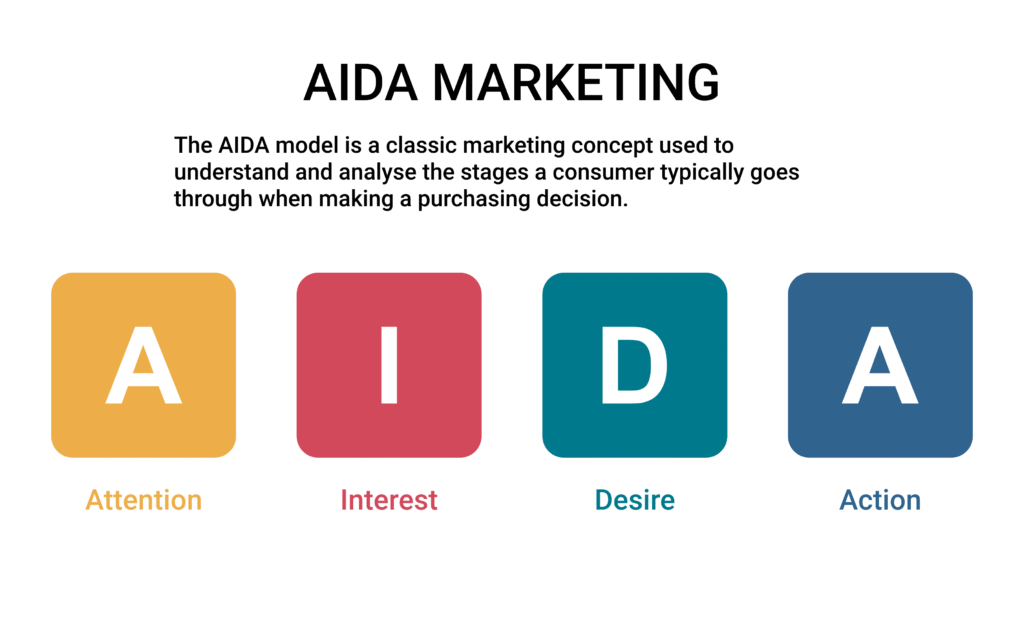
What is the AIDA marketing model?
AIDA is an acronym that stands for the first letters of the English words Attention, Interest, Desire, and Action, which denote individual reactions. It is one of the basic terms in marketing.
The AIDA model is a classic marketing concept used to understand and analyse the stages that a consumer typically goes through when making a purchase decision. The AIDA model is one of several marketing models known as hierarchy of effects models or hierarchical models, all of which indicate that consumers go through a series of steps or stages when making a purchasing decision.
This technique can be used to support sales and marketing activities in content marketing, social media, e-mail marketing, and video.

Dome 3D stickers – make your brand stand out!
History of the AIDA model
The AIDA framework was first proposed by Elijah Elmo Lewis in 1898, when he published a series of articles on marketing and advertising strategies. Lewis, a pioneer in the field of marketing and advertising, recognised the importance of sequentially capturing the attention of potential customers, building their interest, creating their desire for a product or service, and persuading them to take specific action, such as making a purchase. Lewis described this process as the “basic process of customer motivation”
His work had a huge impact on the development of marketing theory, and to this day, the AIDA model is used as a foundation in planning marketing campaigns and sales strategies. Despite the passage of time and the development of new marketing methods and techniques, the basic assumptions of the AIDA model remain relevant, proving its universality and effectiveness.
AIDA Model – Four Stages in the Purchasing Process
The AIDA model, also known as the sales funnel, consists of four main stages (touchpoints):
- Attention
- Interests (Interest)
- Desire
- Action

The first stage is Attention. The task at this stage is to attract the consumer’s attention. This is a key moment when marketers try to distinguish their offer from many others available on the market and build brand awareness.
Then, in the phase of interests (Interest), the goal is to build interest in the product or service offered by showing its unique features and benefits.
Stage desire is intended to evoke in the consumer a strong desire to possess a product or use a service.
The last step, action, focuses on encouraging the customer to take a specific action, such as purchasing a product or signing up for a newsletter. This stage also involves convincing the customer that they will make a good decision
The AIDA model is widely used in marketing strategies due to its simplicity and effectiveness in guiding the target audience through the entire purchasing process. The AIDA model simply indicates how advertising affects the customer and what the subsequent reactions of the consumer to the product are.
Attention
The first stage – attention-grabbing, aims to arouse the interest of a potential customer. This is a key moment in which marketers try to distinguish their offer from many others available on the market.

Attention, as the first step in the AIDA model, is essential to the success of any marketing campaign. Marketers use a variety of techniques, such as intriguing headlines, bright colours, and striking images, to catch the eye of potential customers.
It is important that the message is engaging enough to keep the consumer longer with a given advertisement or offer. These strategies are designed not only to attract attention but also to arouse curiosity and interest in the product or service. Achieving this goal opens the way to the next stages of the AIDA model, ultimately leading to the customer’s attention and decision to purchase.
- At this stage, it is recommended to:
- Using catchy headlines and subheadings
- Arousing customer interest through the use of attractive visualisations
- Placing ads in the right places

At this stage, it is worth using personalised phrases that will arouse the consumer’s curiosity – try to avoid typical sentences such as “We offer…” or “We deal with…”. Focus on slogans and original graphic elements to attract the customer’s attention with a message that stands out from the competition.
Promotional stickers – connect with the client

Interest, or customer interest
Interest – from English interest– is related to the second letter of the model. Once you have managed to grab the consumer’s attention, you need to think about how to further increase their interest in a specific product or service. Raise problems and point out that your company can help solve them, with the products and services you offer.

To attract the customer, it is crucial to show them the benefits of our product or service. It is extremely important that the communication is directed directly to the needs and desires of the recipient. The use of storytelling, or telling a story, can significantly increase interest in the offer. The potential customer is ready to make an effort to find additional information about the product he is interested in, thanks to which he may feel the desire to have it
It is also worth using rhetorical questions in marketing content, which will make the recipient think and realise the need for the product. Presenting opinions and reviews from satisfied customers helps build trust and increase interest. Personalisation of the offer, so that it meets the specific requirements and preferences of the customer, is invaluable at this stage.
Demonstrating a product through video or animation can better present its value and functionality. Organising webinars or live sessions on social media allows for direct dialogue with potential customers and answering their questions in real time.

Arousing customer interest by presenting the benefits of purchasing a product or using a service, also offering personal discounts.
Implementing limited-time offers creates a sense of urgency to engage with the offer now. Finally, remember to continually test different marketing approaches and content to optimise your customer engagement strategy at this stage.
The element you should focus on is also effective promotion and advertising, e.g. on the web. It is also worth focusing on promotional means offline, such as advertising stickers, rubber magnets, or key rings with the company logo from POLINAL.
Desire
The third letter of the model is related to the English word “desire”. The point is that a recipient interested in your product not only decided that he liked it, but he also wanted to buy it or use its services.

In the third stage of the AIDA marketing funnel, desire, it is crucial to create a strong emotional bond between the product and the potential customer. This is achieved by emphasising the unique features of the product and showing how they can satisfy specific desires or solve the customer’s problems. It is important that the marketing message is directed directly to the needs and expectations of the recipient, making the offer not only attractive but also felt as necessary.

The message should also build an image of the product as a source of pleasure or convenience that will introduce positive changes in the customer’s life. Effectively induced desire translates into a greater chance of moving on to the last stage of the model – action.
Your job is to convince a potential customer that a given product is something they really need and will be the best choice. Highlight the strengths of your offer and the benefits it provides to the customer.
Action
The last, very important step is to encourage the recipient to take action – buy the product or use the service. The fourth letter comes from the wordaction, meaning action.
The fourth stage of the AIDA model, action, is the key moment when the customer decides to complete the purchase. This is the time when all the previous stages – attention, interest and desire – must effectively translate into a specific decision. It is therefore important that marketing communication is clear and includes a clear call to action (CTA) that leaves no doubt about the next steps.

Encouraging people to take action can take many forms, from limited-time offers to exclusive discounts to direct invitations to contact them or visit the point of sale.

Using time-limited promotions with a countdown clock is an effective marketing strategy because it creates an element of urgency and encourages customers to make quicker purchasing decisions.
A countdown clock visually highlights the limited availability, which can prompt potential shoppers to act before the sale ends. This method is especially effective in e-commerce, where dynamically showing the elapsed time can significantly increase conversions and sales.

Promotions targeted at one specific day, such as Boxing Day in English-speaking countries, are a great opportunity for consumers to take advantage of extraordinary price reductions. On this day, many stores offer their products at much lower prices, which attracts crowds of bargain hunters.
Stores often prepare special offers that are only available on that one day, which additionally increases the sense of urgency and encourages quick purchases. It is similar to “last-minute” offers in the travel industry. It is now a “burnt iron” tradition that such offers appear, but also that there are customers who wait for them!
If the customer is interested in your offer, they feel the need to choose it. At this stage of the campaign, your goal is to convince them to take the final, most crucial step from the company’s perspective. Call him to contact you in a personalised way!

The effectiveness of the fourth stage of the AIDA model can be significantly increased by ensuring the ease of the purchasing process and minimising potential barriers for the customer. Ultimately, the goal of the action is not just a one-time transaction, but building long-term relationships with the customer that will encourage them to return and make further purchases.

Free product samples for advertising agencies
AIDA Model – AIDA Model Modifications and Variants
The AIDA model is the basis of many marketing strategies, but has evolved over time, giving rise to various modifications and variants. The refinement of the AIDA model stemmed from the need to adapt it to specific industries or sales processes.
AIDAS = AIDA + S (satisfaction)
One of the extensions is the AIDAS model, where the additional letter “S” stands for “Satisfaction”, emphasising the importance of customer satisfaction after a purchase.
AIDCA = AIDA + C (conviction)
Another popular adaptation is the AIDCA model, where the “C” represents “Conviction,” which adds the step of building a strong belief in the value of the offer before the act of purchasing.
AIDCAS – a combination of the two models above
The AIDCAS model extends this even further by incorporating “Satisfaction” into the process.
THERE IS
There is also an ADA model that skips the interest generation stage and focuses on desire and action; it is often used in situations where customers have already shown interest.
REAN – Reach, Engage, Activate, Nurture
The digital era has also seen the emergence of approaches such as REAN (Reach, Engage, Activate, Nurture), which adapt the classic funnel to the online environment by adding stages of engaging and nurturing the customer relationship. Also important are models based on emotions and customer experiences, such as the FEEL-THINK-DO-CARE model, which focuses on emotional engagement and long-term customer loyalty. These adaptations demonstrate the flexibility of the AIDA model and its ability to integrate with new trends and consumer behaviours in the changing world of marketing.
The importance of the AIDA model
The AIDA model, one of the oldest frameworks in marketing, retains its importance through its adaptability to changing market conditions and evolving consumer expectations.
It allows marketers to effectively plan advertising campaigns by focusing on the next stages of the customer’s decision-making process: from attracting attention, through building interest and desire, to persuading them to take action.
The versatility of the AIDA model
Its universality means that the model can be used not only in traditional media but also in the digital world, providing a basis for content marketing strategies or social media campaigns.
The AIDA model also facilitates the personalisation of communication, allowing for better adjustment of content creation to the needs and preferences of recipients at different stages of the purchase path. Finally, it provides a comprehensive approach to building long-term relationships with customers, which is key to maintaining loyalty and a competitive advantage in the market.
AIDA model – an important element of sales activities
The AIDA model works very well in content marketing, social media and direct sales – that’s why it’s worth basing your sales activities and techniques on it. This is a classic sales funnel in the process of purchasing a product or service, aimed at convincing the customer to perform a specific action, such as making a purchase or achieving a particular goal.
Effective advertising should attract attention, encourage further viewing, and arouse the desire to use the offer. If it also prompts the consumer to make a purchase or select a specific service, the company achieves the intended success in the form of another customer!
FAQ – frequently asked questions
-
Are there any modern variations of the traditional AIDA model?
Yes, several variations have emerged to adapt the model to specific industries and modern marketing needs, including AIDAS (adding Satisfaction), AIDCA (adding Conviction), and AIDCAS (combining both extensions). The digital era has introduced approaches like REAN (Reach, Engage, Activate, Nurture) which adapts the classic funnel to online environments. These adaptations demonstrate the flexibility of the AIDA model and its ability to integrate with new trends, consumer behaviors, and digital marketing strategies while maintaining its core effectiveness.
-
What’s the difference between Interest and Desire stages in the AIDA model?
The Interest stage focuses on building customer interest by showing the benefits and unique features of your product or service, often using storytelling, rhetorical questions, and customer testimonials to demonstrate value. The Desire stage goes deeper by creating a strong emotional bond between the product and the customer, emphasizing how the product can satisfy specific needs or solve problems. While Interest makes customers want to learn more about your offer, Desire makes them feel they truly need and must have your product or service.
-
How can I effectively capture customer attention in the first stage of the AIDA model?
To capture attention effectively, you should use catchy headlines and subheadings, attractive visualizations, and place your ads in strategic locations where your target audience will notice them. It’s crucial to avoid typical corporate phrases like “We offer…” and instead focus on personalized messages, original graphic elements, and slogans that stand out from the competition. The goal is to create engaging content that not only attracts attention but also arouses curiosity and keeps consumers interested long enough to move to the next stage.
-
What does AIDA stand for and why is this model still relevant in modern marketing?
AIDA is an acronym that stands for Attention, Interest, Desire, and Action, representing the four stages consumers typically go through when making a purchase decision. This model, first proposed by Elijah Elmo Lewis in 1898, remains relevant because of its adaptability to changing market conditions and its universality across both traditional and digital marketing channels. Despite the development of new marketing methods and techniques, the basic assumptions of the AIDA model prove its enduring effectiveness in guiding customers through the purchasing process.